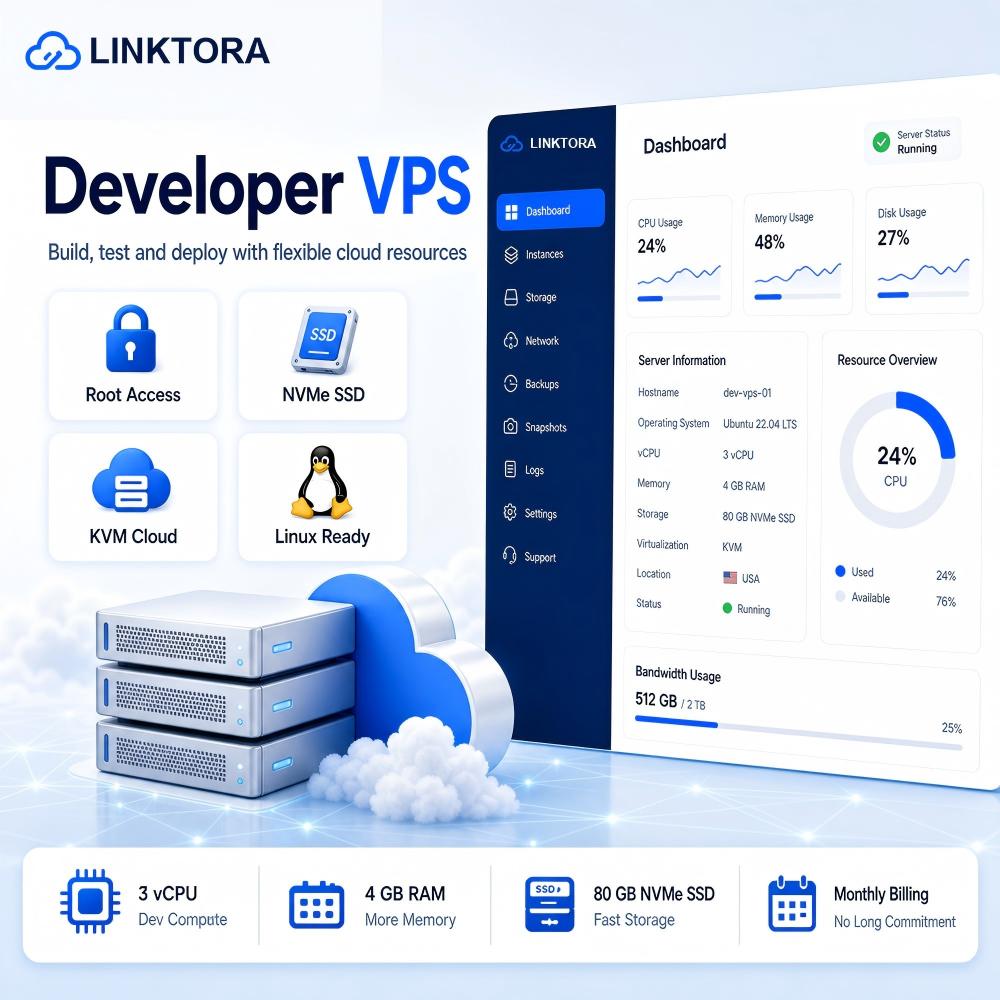
Developer VPS
Developer VPS
Linktora Developer VPS is a flexible cloud server plan built for developers, technical teams and testing environments. Get more CPU, memory and storage than an entry-level VPS, with full root access and simple monthly billing.
Product Details
Overview
Linktora Developer VPS is designed for developers who need a reliable cloud environment for building, testing and running lightweight production workloads. It gives you more resources than a starter server while keeping costs predictable and easy to manage. Whether you are developing a web application, testing APIs, running a staging site, hosting a small backend service or learning cloud deployment workflows, this plan offers a practical balance of performance, control and affordability.
With NVMe SSD storage, KVM virtualization and full root access, Linktora Developer VPS gives you the freedom to configure your server the way your project requires. Install your preferred Linux distribution, manage services from the command line, deploy containers, run databases for development, or set up a private environment for your team. The plan is simple enough for daily development work and powerful enough for growing technical projects.
Who Is This Plan For?
· Developers who need a personal cloud server for projects and testing.
· Startups building early-stage web applications or internal tools.
· Agencies that need staging environments for client websites.
· Technical teams testing APIs, backend services or deployment workflows.
· Users who have outgrown basic shared hosting and need more control.
Key Features
· Full root access for complete server control.
· NVMe SSD storage for faster file access and application performance.
· KVM virtualization for isolated and reliable cloud resources.
· Linux-ready environment for modern development stacks.
· Flexible monthly billing with no long-term commitment required.
· Scalable resources for projects that need room to grow.
· Secure infrastructure suitable for development, staging and lightweight production workloads.
Configuration
|
Field |
Recommended Content |
|
vCPU |
3 vCPU |
|
Memory |
4 GB RAM |
|
Storage |
80 GB NVMe SSD |
|
Bandwidth |
2 TB monthly transfer |
|
Virtualization |
KVM |
|
Operating Systems |
Ubuntu, Debian, AlmaLinux, Rocky Linux and other supported Linux distributions |
|
Access |
Full root access |
|
Billing |
Monthly subscription plan |
|
Support |
Ticket and email support |
Selling Points
NVMe SSD Storage: Fast storage designed for responsive websites, scripts and lightweight applications.
Full Root Access: Install software, configure services and manage the server environment with full administrative control.
Developer Friendly: A clean cloud server environment suitable for Linux learning, testing and deployment.
Flexible Upgrade Path: Move to Developer VPS, Business VPS or higher plans as your workloads grow.
Secure Infrastructure: Designed for stable hosting workloads with secure access and isolated virtual resources.
Predictable Pricing: A clear monthly plan with simple specifications and no confusing product structure.
Applicable Scenarios
· Personal website hosting
· Small business website hosting
· Development and testing environment
· Lightweight web application deployment
· API testing and backend experiments
· Linux server learning and practice
· Staging server for WordPress or custom websites
FAQ
FAQ
1. What is the difference between Cloud VPS and Shared Hosting?
Cloud VPS provides dedicated virtual server resources such as vCPU, RAM and storage, giving you more control, flexibility and scalability. It is suitable for developers, growing websites, applications and businesses that need better performance.
Shared Hosting places multiple websites on a shared server environment. It is easier to manage and more affordable, making it ideal for personal websites, small business sites, portfolios and simple company websites.
2. Which hosting option should I choose?
Choose Shared Hosting if you want a simple, affordable hosting plan for a website, blog, portfolio or small business page.
Choose Cloud VPS if you need more server control, higher performance, root access, custom software installation or scalable resources for growing projects.
3. Is technical knowledge required?
For Shared Hosting, basic website knowledge is usually enough. The hosting environment is simplified and easier to manage.
For Cloud VPS, some server administration knowledge may be required, especially if you plan to manage Linux, SSH, firewall rules, databases or custom applications yourself. If you are not familiar with server management, a managed plan or technical assistance may be recommended.
4. How long does setup take after purchase?
Most hosting services are provisioned after order confirmation and payment verification. Shared Hosting accounts are usually activated quickly, while Cloud VPS deployment may take a short period depending on the selected configuration, operating system and review requirements.
In normal cases, access details will be provided after the service is ready.
5. Do you provide a control panel?
Shared Hosting generally includes a user-friendly hosting control panel for managing websites, domains, email accounts, databases, files and SSL settings.
Cloud VPS may include a server management panel or console depending on the selected plan. Some VPS plans may require customers to manage the server via SSH or remote access.
6. Can I upgrade my hosting plan later?
Yes. Hosting plans can usually be upgraded when your website or application grows. You may upgrade resources such as CPU, RAM, storage, bandwidth or service level depending on the product type.
For Cloud VPS, upgrades may involve resource scaling.
For Shared Hosting, upgrades may involve moving to a higher hosting plan.
7. Can I host WordPress websites?
Yes. Both Cloud VPS and Shared Hosting can be used to host WordPress websites.
Shared Hosting is suitable for standard WordPress sites, blogs and small business websites.
Cloud VPS is better for high-traffic WordPress sites, WooCommerce stores, custom plugins, staging environments and performance-sensitive projects.
Service Notes
Service Notes
1. Service Type
Cloud VPS and Shared Hosting are digital infrastructure services. No physical goods will be shipped. After successful payment and order review, service access details will be delivered electronically through email, customer account dashboard or support communication.
2. Account Activation
Service activation may require successful payment confirmation and basic order verification. Some orders may be reviewed manually for fraud prevention, abuse prevention or security reasons.
Estimated activation time may vary depending on the selected product, configuration and payment status.
3. Billing Cycle
Hosting services are generally billed on a recurring basis, such as monthly or yearly billing. The selected billing cycle will be displayed during checkout or in the product description.
Customers are responsible for renewing services before expiration to avoid service suspension or data loss.
4. Renewal and Expiration
If a service is not renewed before the due date, it may be suspended. If the service remains unpaid after the grace period, it may be terminated and associated data may be permanently deleted.
Customers should renew on time or enable automatic renewal if available.
5. Resource Allocation
Each hosting plan includes specific resource limits such as CPU, RAM, storage, bandwidth, websites, email accounts or databases. These resources are subject to fair usage and technical availability.
Cloud VPS resources are generally more isolated and scalable. Shared Hosting resources are shared across a managed server environment.
6. Acceptable Use
The service must be used for lawful and legitimate purposes. Prohibited activities may include but are not limited to:
- Spam or bulk unsolicited email
- Phishing or fraudulent websites
- Malware, viruses or harmful scripts
- Copyright-infringing content
- Illegal file sharing
- Network abuse or port scanning
- DDoS activity or attack traffic
- Botnet, command-and-control or abusive automation
- Hosting content that violates applicable laws or platform policies
Accounts involved in abusive activity may be suspended or terminated.
Share